
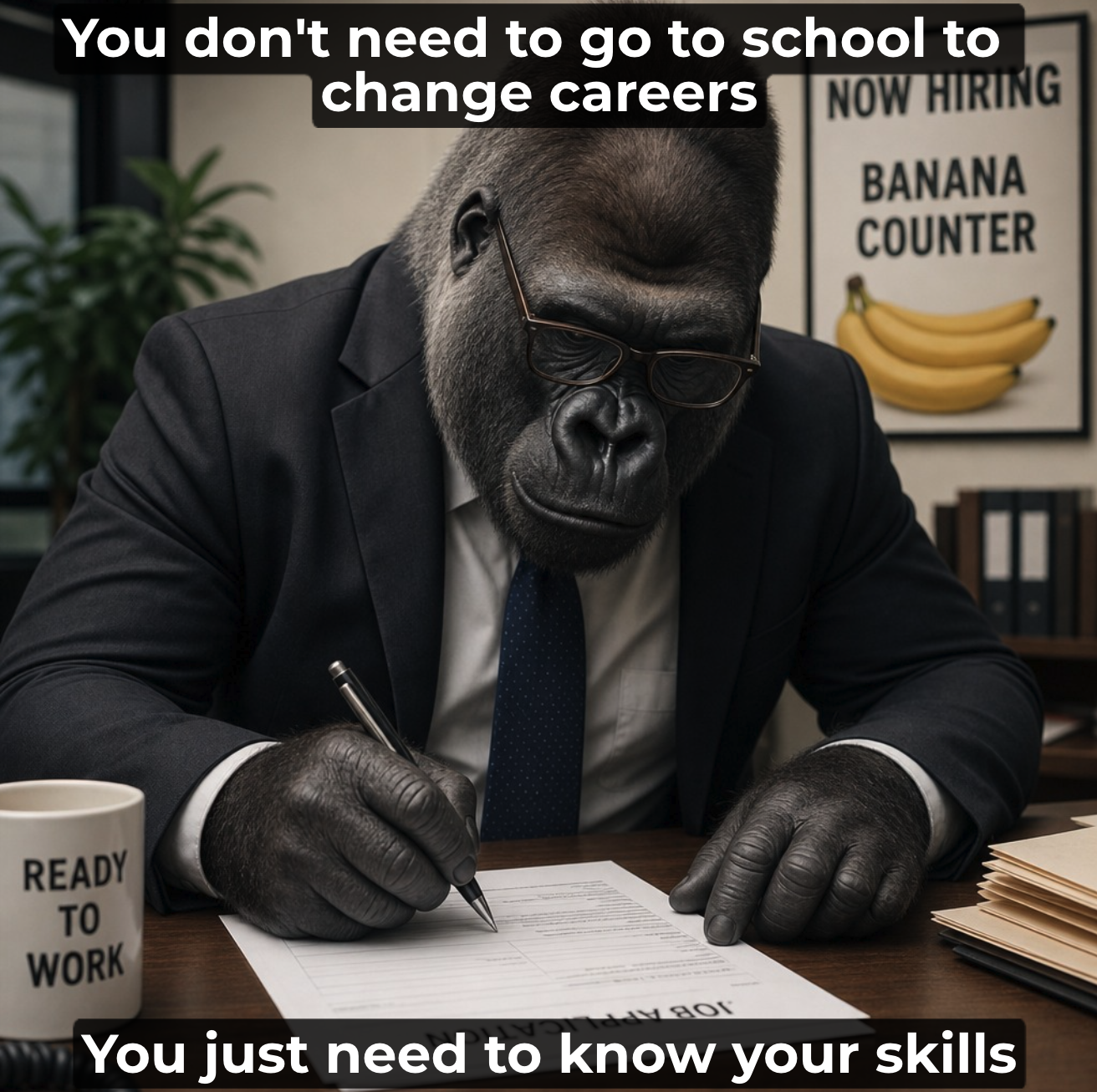
Greetings, my fellow primates!
Have you ever looked at your career and thought:
“I don’t want to do this anymore.”
Maybe you’re bored. Maybe you’re burned out. Maybe you’ve discovered that your lifelong dream is actually to count bananas professionally.
Whatever the reason, changing careers can feel intimidating. And one of the first things people think about is going back to school.
But here’s the thing:
You don’t always need another degree to change careers.
Sometimes, you just need to figure out what you’re already good at and find a new jungle where those skills are useful.
I know this because I have never been to school.
And somehow I run a business.
So let Kuba explain.
🦍 Step 1: Figure Out What You’re Actually Good At
Before you start applying for jobs, take inventory of your skills.
Not just your job title.
Your skills.
Maybe you’re good at:
- Solving problems
- Communicating with people
- Organizing things
- Writing
- Programming
- Managing projects
- Analyzing data
- Selling things
- Fixing things
- Learning new technology
- Counting bananas extremely quickly
Don’t underestimate skills just because you’ve been using them in a particular industry.
A gorilla who has spent ten years organizing bananas has developed some serious inventory-management abilities.
That’s not just banana experience. That’s transferable skills.
🍌 Step 2: Look for Transferable Skills
This is where career changes become interesting.
You don’t necessarily need to start from zero.
You need to figure out how the things you already know can apply somewhere else.
For example:
Customer service → Sales
You already know how to communicate with people, understand their problems, and help them find solutions.
Teaching → Corporate training
You already know how to explain complicated things to people who don’t understand them yet.
Project management → Operations
You already know how to coordinate people, deadlines, resources, and approximately 700 things that go wrong at the same time.
Software development → Many, many things
Programming teaches you problem-solving, logical thinking, debugging, and how to stare at a computer screen for eight hours wondering why something doesn’t work.
And if none of those sound appealing…
Banana Counter.
Kuba has been preparing for this career his entire life.
📝 Step 3: Rewrite Your Resume Around Your Skills
One mistake people make when changing careers is presenting themselves entirely through the lens of their old career.
Instead of:
“I have 8 years of experience doing X.”
Try thinking:
“I have 8 years of experience solving these particular problems using these particular skills.”
That’s much more useful when applying to a new field.
Your previous job doesn’t have to define your future job.
Kuba’s resume would say:
Relevant Skills:
- Counting
- Attention to detail
- Problem solving
- Strong work ethic
- Advanced banana identification
- Can lift heavy things
- Willing to work around bananas
Suddenly, Kuba is looking pretty qualified.
🦍 Step 4: Learn What You Actually Need to Learn
Now, this doesn’t mean never learn anything new.
Sometimes a career change does require new knowledge or certifications.
But there’s a big difference between:
“I need to learn a specific skill.”
and
“I need to spend four years and $80,000 getting a completely new degree.”
You may be able to learn what you need through:
- Online courses
- Books
- Tutorials
- Certifications
- Personal projects
- Volunteer work
- Freelancing
- Internships
- Practicing on your own
The internet contains an absolutely ridiculous amount of information.
Kuba taught himself how to read and use the internet.
He also accidentally subscribed to 47 banana recipe newsletters.
But progress is progress.
🧠 Step 5: Start Before You Feel Ready
You might never feel completely ready to change careers.
That’s okay.
You don’t need to know everything before you begin.
Start researching jobs.
Talk to people who already work in the field.
Look at job postings and see which skills employers actually want.
Then identify the gaps between:
What you can do now
and
What you need to be able to do.
Then start closing those gaps.
One banana at a time.
💼 Step 6: Don’t Ignore Your Existing Experience
This is especially important.
Changing careers doesn’t mean your previous experience suddenly becomes worthless.
You bring everything you’ve learned with you.
Maybe you’ve learned how to deal with difficult customers.
Maybe you’ve managed a team.
Maybe you’ve worked under ridiculous deadlines.
Maybe you’ve learned how to troubleshoot problems at 2 AM while questioning every decision you’ve ever made.
Those experiences still count.
You’re not starting over.
You’re starting from a different place.
🍌 Kuba’s Final Advice
If you want to change careers, don’t immediately assume you need to go back to school.
First, ask yourself:
What am I good at?
What do I enjoy doing?
What problems can I solve?
What skills do I already have that another industry might value?
Then look for opportunities where those skills fit.
You might discover that you need a new degree.
You might discover that you need a certification.
Or you might discover that you already have most of what you need.
You just need to present your skills differently.
And if all else fails…
Become a banana counter.
There are approximately 37 bananas on this desk.
Kuba is available for employment.
Chest thumps and career transitions,
Kuba Pudding Jr. 🦍
P.S. Kuba’s current career goal is to become a professional banana inspector. He has already rejected 14 bananas for “suspicious curvature.”
Leave a Reply